
SEO vs GEO vs AEO: Which One Does Your Business Need?
The way people search online has changed dramatically over the past few years. Search engines are no longer the only place people go to find answers. Today, users ask AI assistants, rely on voice search, and expect instant, accurate responses instead of scrolling through pages of results.
For businesses, this shift has changed the rules of digital visibility. Ranking on Google is still important, but it’s no longer the complete picture. To stay competitive in 2026, brands need to understand how different search experiences work and how their content fits into each one.
That’s why understanding SEO vs GEO vs AEO has become essential. Each approach focuses on a different way people discover information online, and together they can help your business reach customers wherever they’re searching.
Let’s explore what each one means and how to decide which strategy deserves your attention.
What is SEO?
Search Engine Optimisation (SEO) is the foundation of online visibility. It focuses on improving your website so that it ranks higher on traditional search engines like Google and Bing when users search for relevant topics.
The better your website is optimised, the easier it becomes for potential customers to discover your business organically.
Core elements of SEO include:
- Researching and targeting relevant keywords
- Creating valuable, informative content
- Optimizing title tags, meta descriptions, and headings
- Improving website speed and mobile responsiveness
- Building high-quality backlinks
- Maintaining a strong technical website structure
SEO continues to play a major role in helping businesses attract consistent, long-term organic traffic.
What is GEO?
Generative Engine Optimisation (GEO) is one of the newest developments in digital marketing. Instead of focusing only on search rankings, it prepares your content to be understood, summarised, and referenced by AI-powered search platforms and generative tools.
As AI becomes a preferred way for people to find information, businesses need content that AI systems can easily interpret and trust.
GEO focuses on:
- Writing clear and context-rich content
- Structuring information for easy AI interpretation
- Maintaining factual accuracy
- Using schema and structured data where appropriate
- Keeping brand information consistent across all online platforms
- Building authority and credibility through high-quality content
Rather than simply ranking on a search engine, GEO helps your brand become part of AI-generated responses.
What is AEO?
Answer Engine Optimisation (AEO) is designed around one simple goal: giving users the exact answer they’re looking for as quickly as possible.
Whether someone is using voice search, asking a smart assistant a question, or looking for a featured snippet, AEO helps your content become the answer instead of just another search result.
Important AEO practices include:
- Answering common customer questions directly
- Creating dedicated FAQ sections
- Using conversational language
- Organizing content with headings and lists
- Keeping answers concise and easy to understand
- Optimizing for voice-based searches
This approach works especially well because today’s users often want immediate answers instead of reading lengthy articles.
SEO vs GEO vs AEO: Understanding the Difference
Although these strategies work toward the same goal of improving online visibility, they approach it differently.
Here’s how they compare:
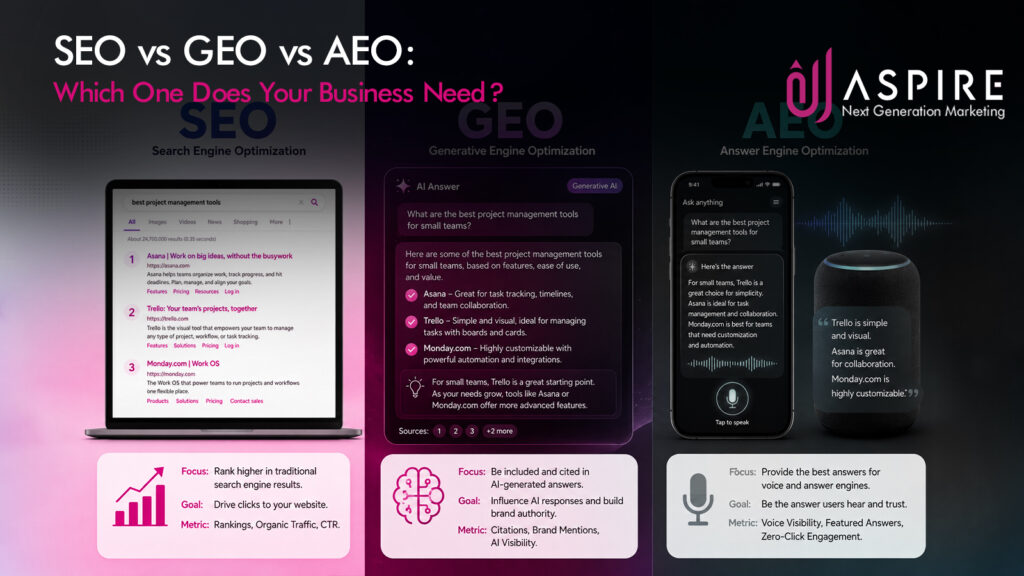
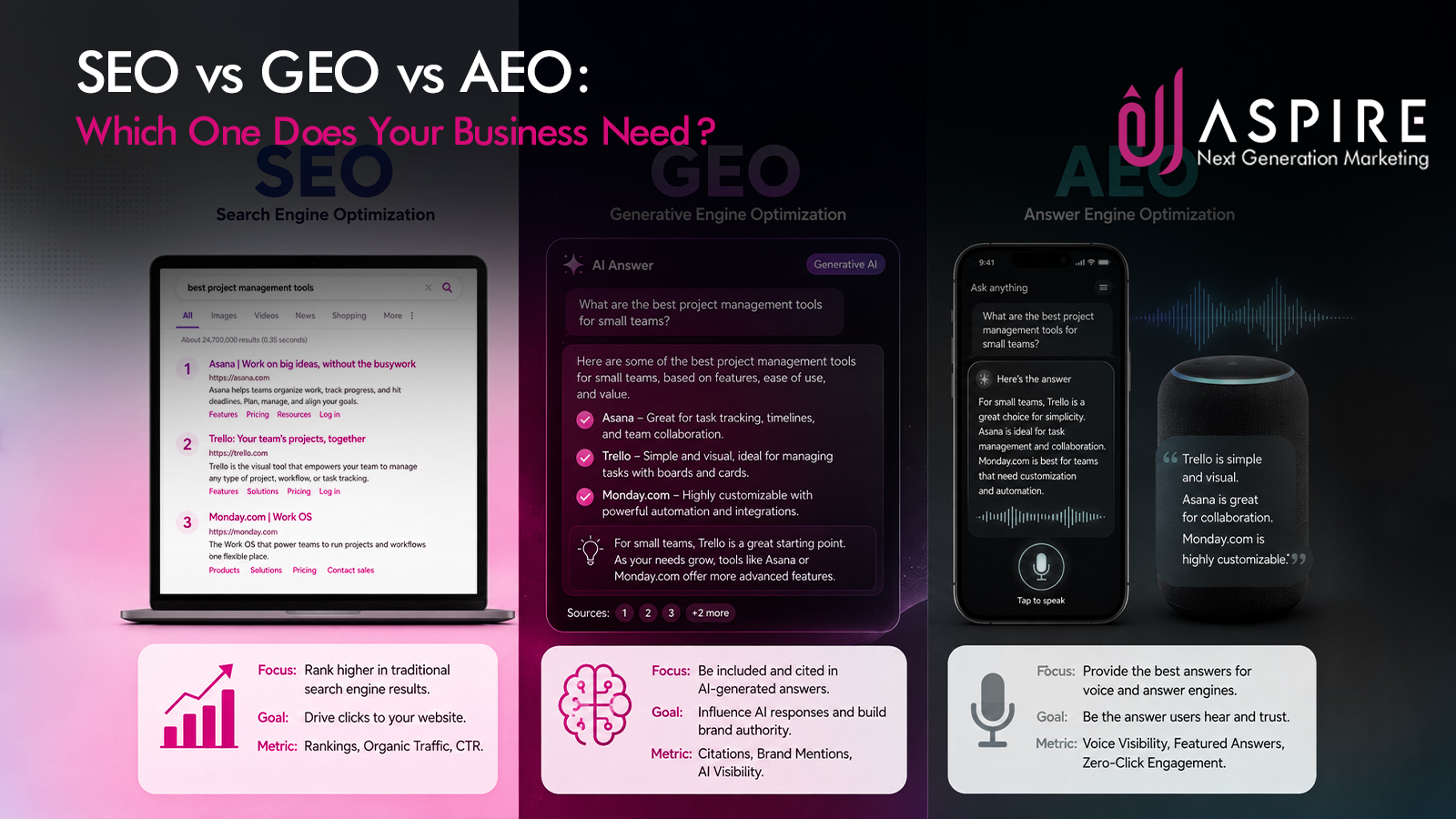
SEO
- Focuses on traditional search engine rankings
- Relies on keyword optimization
- Builds authority through backlinks
- Prioritizes technical website performance
GEO
- Focuses on AI-generated search experiences
- Helps AI understand and summarize your content
- Relies on clarity, structure, and authority
- Encourages consistent brand information everywhere online
AEO
- Focuses on answering user questions directly
- Targets featured snippets and voice assistants
- Uses FAQs and conversational formatting
- Prioritizes quick, accurate responses
The biggest takeaway is that these strategies complement each other rather than compete.

Which Strategy Does Your Business Need?
The answer depends on your business goals, audience, and how your customers prefer to search.
SEO is ideal if you:
- Want steady long-term organic traffic
- Rely heavily on Google search visibility
- Publish blogs and educational content
- Want stronger website authority
GEO is valuable if you:
- Want your brand mentioned by AI search tools
- Publish expert content regularly
- Want to prepare for the future of search
- Need consistent visibility across multiple AI platforms
AEO is useful if you:
- Want to appear in featured snippets
- Receive many customer questions
- Serve local customers
- Want better visibility in voice search
For many businesses, especially service providers and e-commerce brands, combining all three delivers the strongest results.
Why This Matters More Than Ever in 2026
Consumer search habits are evolving rapidly.
People increasingly rely on AI chatbots, voice assistants, and conversational search experiences before making purchasing decisions. Instead of browsing through multiple websites, they often expect one trustworthy answer.
Some of the biggest trends shaping search today include:
- AI-generated recommendations influencing buying decisions
- Continued growth in voice search
- Demand for faster and more direct answers
- Greater emphasis on trustworthy, structured content
- Consistent brand information across every digital platform
These shifts make SEO vs GEO vs AEO more than just another marketing discussion. They represent the future of how businesses will be discovered online.
How to Build a Balanced Strategy
Instead of choosing one method over another, the smartest approach is to combine the strengths of all three.
A balanced strategy should include:
- A technically optimized website
- Helpful, well-researched content
- Clear headings and structured formatting
- FAQ sections that answer customer questions
- Consistent business information across every platform
- Regular content updates to stay relevant
- Strong authority through quality content and backlinks
When these elements work together, your content becomes easier for search engines, AI platforms, and voice assistants to understand.
This is exactly why many brands are investing in SEO vs GEO vs AEO together rather than treating them as separate marketing activities.
How Aspire Digital Media Can Help
Keeping up with changing search trends can feel challenging, especially when you’re already focused on running your business.
At Aspire Digital Media, we help businesses create digital strategies that are built for both today’s search engines and tomorrow’s AI-driven experiences.
Our team offers:
- Technical SEO optimization
- Content strategy and creation
- Website optimization
- AI-ready content structuring
- Local search optimization
- Performance-driven digital marketing solutions
Instead of chasing every new trend, we focus on building sustainable strategies that improve your visibility across every major search experience.
Whether you’re starting from scratch or looking to strengthen your existing digital presence, Aspire Digital Media helps your brand stay discoverable where your audience is searching.
If you’re ready to build a future-ready digital strategy, we’re here to help.
Final Thoughts
Digital marketing is evolving quickly, and businesses that adapt early will have a significant advantage. Traditional SEO still matters, but it now works alongside AI search optimisation and answer-focused content strategies.
Rather than asking which one is better, the real question is how these approaches can work together to strengthen your online presence.
Understanding SEO vs GEO vs AEO gives businesses the opportunity to stay visible across traditional search engines, AI-powered platforms, and voice assistants, ensuring they remain relevant as search continues to evolve.
FAQs
Posting 3 to 5 times per week, along with regular Stories and Reels, helps maintain visibility and engagement.
Food photography, behind-the-scenes videos, customer testimonials, and limited-time offers usually perform best.
Most restaurants begin seeing noticeable improvements within 2 to 3 months of consistent content efforts.
Yes. Local SEO helps your restaurant appear when nearby customers search for dining options online.
Professional support can save time, improve content quality, and create a more effective long-term marketing strategy.