
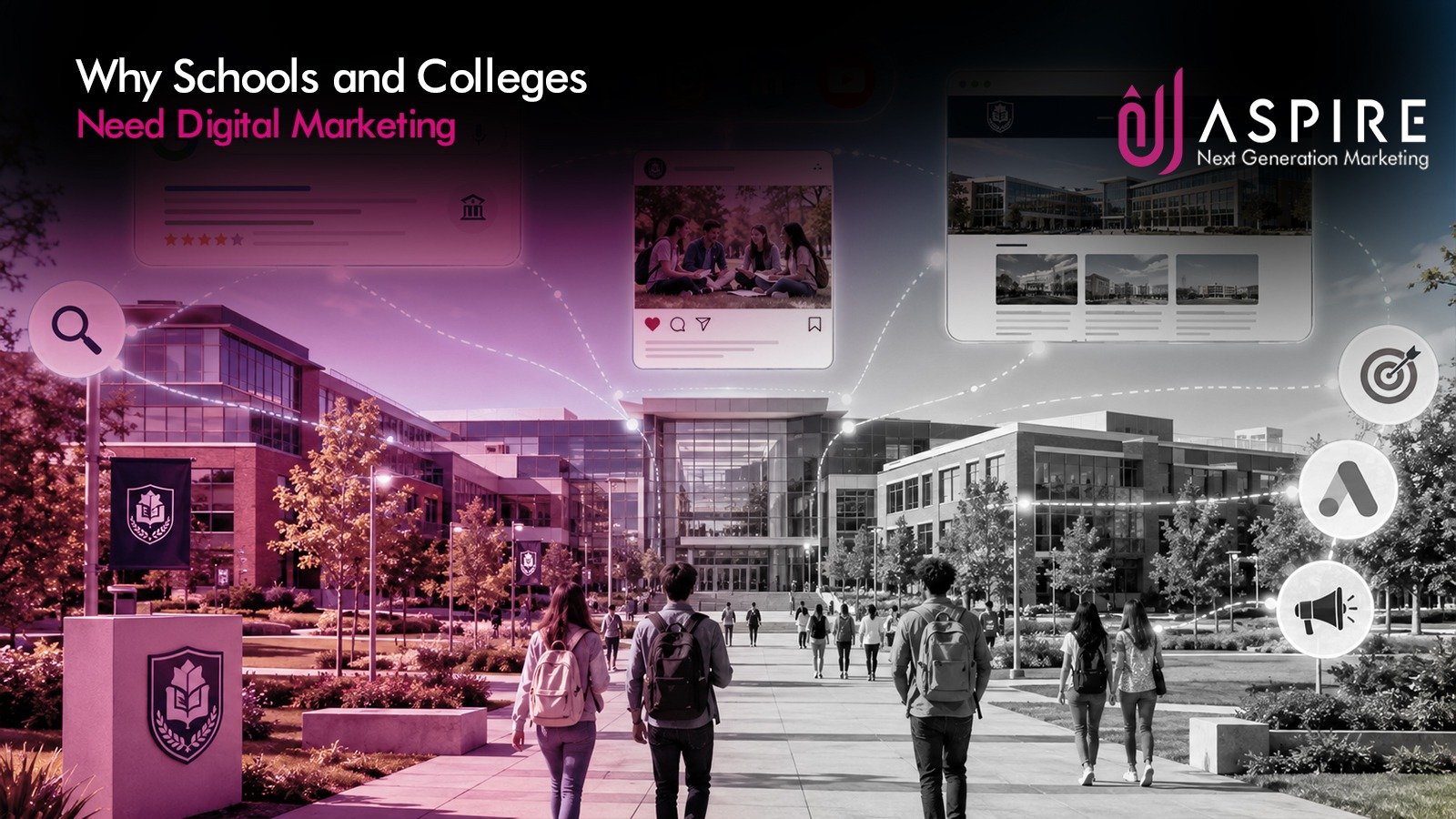
Why Schools and Colleges Need Digital Marketing
Educational institutions today operate in a completely changed recruitment and communication landscape. Students, parents, and educators now rely heavily on digital channels to discover and evaluate educational institutions. Printed brochures, local newspaper advertisements, and word-of-mouth referrals still have value, but they are no longer enough for strong visibility.
Schools and colleges that do not embrace strategic digital marketing may face declining enrolments, weaker competitiveness, and reduced stakeholder engagement. Institutions that use digital marketing for education strategically can improve visibility, strengthen student recruitment, build community connections, and expand their institutional influence.
The Transformation of Educational Decision-Making
The way families choose schools and colleges has changed significantly. This shift explains why digital marketing for education has become an important part of institutional operations.
- Digital research dominance: 92% of families conduct online research before making educational decisions.
- Social proof emphasis: Student testimonials, parent reviews, and alumni success stories influence institutional selection decisions.
- Mobile-first information seeking: Families expect information to be easily accessible on smartphones and tablets, whenever they need it.
- Competitive transparency: Prospective students and parents compare several institutions at the same time, making it important to clearly communicate what makes an institution different.
- Geographic boundary dissolution: Digital channels allow institutions to attract students beyond their traditional geographic catchment areas.
- Influencer and peer networks: Institutional reputation is increasingly shaped by organic social sharing and peer recommendations across digital networks.
- Immediate response expectations: Families expect quick responses to enquiries. Delays can make them feel that an institution is not interested in their concerns.
Ignoring these realities can create recruitment challenges and competitive disadvantages.
Why Traditional Marketing Alone Falls Short for Educational Institutions
Educational institutions have traditionally depended on marketing methods designed for a pre-digital world. While these methods have been useful historically, they often deliver limited results without digital integration.
- Limited reach and penetration: Print advertising usually reaches narrower demographic segments, while digital channels can cover family audiences across locations.
- One-way communication: Traditional marketing mainly delivers a message. Digital platforms allow institutions to have two-way conversations and respond to specific questions.
- Delayed feedback cycles: Print campaigns offer limited performance information, while digital platforms provide real-time analytics on engagement and message effectiveness.
- High production costs with uncertain ROI: Print design, production, and distribution can require substantial investment, while exact outcomes can be difficult to track.
- Inability to target precision demographics: Traditional media broadcasts to broad audiences. Digital platforms allow segmentation by interests, behaviour, and characteristics.
- No dynamic content updating: Printed materials can quickly become outdated. Digital content can be updated instantly with current programmes, achievements, and institutional news.
- Limited storytelling capability: Print space limits narrative depth, while digital platforms support multimedia and case studies.
The effective approach is to integrate traditional and digital methods.
Key Digital Marketing Strategies for Schools and Colleges
A digital approach brings together strategies for institutional goals.
Website Optimization and User Experience
A school or college website is often one of the first places families visit while researching an institution.
- Intuitive navigation architecture: Organise the website around family priorities such as admissions, academics, student life, and achievements.
- Mobile responsiveness: Ensure website elements work smoothly on smartphones and tablets.
- Fast load speeds: Optimise technical performance to improve search visibility.
- Clear calls-to-action: Place admission inquiry forms, event registration links, and contact options strategically.
- Accessibility compliance: Follow web accessibility standards for accessible navigation.
- Video integration: Use campus tours, student testimonials, faculty introductions, and programme highlights.
Search Engine Optimization (SEO)
Search engines are important when families look for educational options.
- Local search dominance: Optimise for searches such as “best schools near me” and “colleges in Kolkata”.
- Academic programme visibility: Target searches such as “engineering colleges”, “liberal arts education”, and “STEM curriculum”.
- Keyword research and targeting: Identify the search terms families actually use and build content around them.
- Content creation strategy: Develop blog posts, programme guides, and resources that answer common institutional questions.
- Link building: Build references from educational directories, local business listings, and relevant institutional partners.
- Technical SEO: Use structured data, XML sitemaps, and technical improvements to support crawling and indexing.
Social Media and Community Building
Social media can show the people and experiences behind the prospectus.
- Platform-specific strategies: Use Instagram for visual campus life, Facebook for parent community building, and LinkedIn for alumni networking and employer connections.
- Content calendar discipline: Maintain consistent posting schedules to stay visible and build reliability.
- Authentic storytelling: Share genuine student experiences, faculty achievements, and campus culture through student-generated content.
- Parent and family engagement: Create communities where families can connect, share experiences, and maintain relationships.
- Alumni networking: Use social platforms to celebrate alumni achievements, maintain connections, and support mentorship relationships.
- Crisis communication readiness: Establish protocols for addressing negative sentiment and protecting institutional reputation.
Paid Advertising and Lead Generation
Paid campaigns can reach prospective students and decision-making parents precisely.
- Targeted student recruitment: Run advertisements based on academic interests, geographic location, and demographic characteristics.
- Remarketing campaigns: Re-engage website visitors who showed interest but did not complete an inquiry or application.
- Parent-targeted messaging: Create advertisements that speak directly to parental priorities and institutional strengths.
- Event promotion: Promote campus visits, information sessions, and open houses to increase attendance.
- Seasonal campaign optimisation: Adjust advertising intensity around academic calendars and deadlines.
- Budget efficiency: Continuously optimise spending to generate qualified leads at a sustainable cost.
Email Marketing and Nurturing
Email remains useful for communication with prospective students, parents, and alumni.
- Prospect nurturing sequences: Use automated email paths to guide enquiries through admission processes with relevant information at each stage.
- Parent engagement programmes: Send newsletters featuring institutional news, student achievements, and upcoming events.
- Segmented communication: Tailor messages according to student interests, academic levels, and engagement history.
- Event invitations and reminders: Promote campus visits, information sessions, and virtual tours.
- Alumni engagement: Maintain regular communication, celebrate achievements, and encourage mentorship and giving.
Measurable Benefits
When institutions implement strategic digital marketing for education initiatives, they can see measurable improvements across recruitment and engagement.
- Increased website traffic: A well-optimised digital presence can attract 3-5x more prospective student and family visitors compared to pre-digital strategies.
- Improved lead quantity and quality: Targeted campaigns can generate more enquiries from genuinely interested prospective students.
- Reduced recruitment costs: Digital strategies can achieve enrolment objectives at a substantially lower cost per student compared to traditional marketing.
- Enhanced institutional reputation: A consistent digital presence and positive social proof can strengthen institutional brand perception.
- Faster decision-making: Easy access to comprehensive information can help families reach enrolment decisions more efficiently.
- Improved stakeholder satisfaction: Responsive digital communication can address family questions promptly.
- Competitive differentiation: A sophisticated digital presence can position institutions as forward-thinking, tech-competent organisations.
- Geographic expansion: Digital reach can attract students beyond traditional geographic areas.
- Data-driven optimisation: Analytics can reveal which strategies drive actual enrolments, enabling continuous improvement.
- Alumni engagement improvement: Digital channels can facilitate ongoing alumni connections and strengthen loyalty.
Tracking these metrics enables continuous institutional improvement and ROI validation.
Aspire Digital Media: Transforming Educational Institutions Through Strategic Digital Marketing
Aspire Digital Media specialises in comprehensive digital marketing for education solutions tailored to schools, colleges, and educational organisations. The agency understands enrolment seasonality, multiple stakeholder audiences, accreditation requirements, and limited budgets.
Its educational marketing expertise includes:
- Education-sector specialisation: Understanding institutional dynamics, regulatory environments, and sector-specific challenges.
- Multi-stakeholder campaigns: Coordinating messaging across students, parents, teachers, and community stakeholders.
- Seasonal recruitment optimisation: Aligning digital efforts with academic calendars and deadlines.
- Reputation management: Building and protecting institutional brands through strategic content and crisis communication protocols.
- Technology integration: Implementing marketing automation, CRM systems, and analytics platforms for data-driven decisions.
- Measurable outcomes: Providing transparent reporting that demonstrates ROI through enrolment growth and engagement.
Partner with the agency to strengthen your institution’s digital presence and enrolment outcomes. Whether you are a school strengthening local recruitment or a college expanding geographic reach, the agency combines strategic planning, technical expertise, and educational sector insight to deliver results.
FAQs
Digital presence protects market position during market fluctuations and attracts higher-quality applicants. Even strong institutions benefit from demonstrating innovation and accessibility.
Absolutely. Digital strategies often cost less than traditional marketing while delivering strong results. Schools can start with website optimisation and social media, then scale gradually.
Most institutions see initial lead generation within 2-3 months; enrolment impact typically appears within one academic cycle. Consistent effort compounds results.
Both approaches work. Many institutions combine in-house management with agency support for specialised services, depending on budget, staffing capacity, and strategic priorities.
Costs vary by institution size and strategy scope. Effective programmes range from modest budgets for local schools to significant investments for national-reach colleges, with ROI remaining a key consideration.